
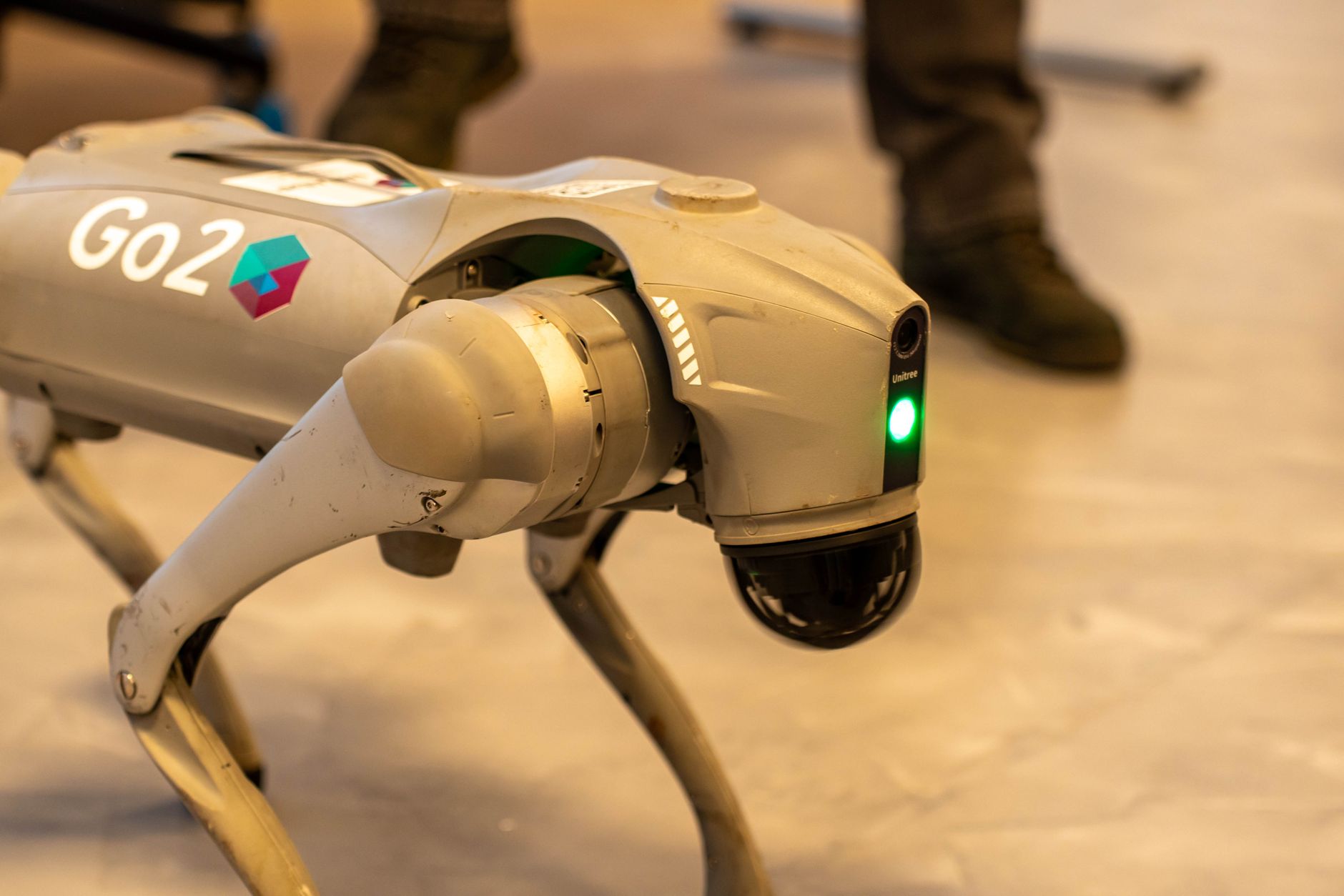
Teaching robots to perform a wide variety of tasks—from running across uneven terrain to assembling delicate objects—remains a major challenge in artificial intelligence. A newly published research paper introduces a smarter way to train robots in simulation that could help them learn faster and more effectively. This work is important because it tackles a common bottleneck in robot learning: how to focus training on the most useful experiences so that robots can quickly improve their skills without wasting time on tasks they’ve already mastered or aren’t ready for yet.
Key Takeaways
- The researchers developed a method called Success Guided Sampling (SGS) that adaptively focuses training on tasks near the robot’s current skill level, rather than sampling tasks randomly.
- SGS enables training across over one million simulated environments running in parallel, making large-scale robot learning more efficient.
- This approach helps robots learn complex skills like multi-terrain walking and precise assembly tasks that previous methods struggled with.
- Policies learned in simulation were successfully transferred to real robots performing challenging assembly tasks without additional training, showing promising real-world potential.
Robots are typically trained using a technique called reinforcement learning (RL), where they try out many actions in a simulated environment to discover what works best. However, current RL approaches often rely heavily on carefully designed task setups and human guidance, which can be time-consuming and limit general flexibility. One way to reduce this engineering effort is to reset simulations to diverse starting points, exposing the robot to a wide variety of scenarios. But when these resets are chosen uniformly at random, much of the robot’s learning time is spent on tasks that are either too easy (already mastered) or too hard (not yet achievable), wasting valuable training resources.
The researchers behind this new study identified this inefficiency as an “exploration bottleneck” in large-scale RL for robot control. To address it, they introduced Success Guided Sampling (SGS), an adaptive method that prioritizes sampling tasks around the “frontier” of what the robot can currently do. In other words, SGS focuses training on tasks that are just challenging enough to push the robot’s abilities forward without overwhelming it.
Conceptually, SGS works by monitoring the robot’s success rates on different tasks and dynamically adjusting which scenarios to present next. Tasks that the robot frequently succeeds at are sampled less often, while those where the robot is making progress or struggling are sampled more. This targeted sampling ensures that the robot’s learning experience is concentrated where it can yield the most improvement.
To test their approach, the team ran experiments with up to one million parallel simulated environments, a scale far beyond typical RL training setups. Using SGS, they successfully trained robots to perform complex quadruped locomotion over multiple terrains and to complete contact-rich assembly tasks—areas where previous methods had difficulty. Importantly, they also demonstrated that manipulation policies learned in simulation could be transferred “zero-shot” to real-world robots using only RGB camera inputs, without further training or fine-tuning.
This research represents a step forward in making robot learning more scalable and less dependent on manual engineering of each task. By focusing training on the most informative experiences, SGS could accelerate the development of general-purpose robots capable of adapting to diverse and dynamic environments. Future work may explore extending this approach to even broader classes of tasks and integrating it with other advances in robot perception and control. For now, SGS offers a promising strategy to help robots learn smarter, not just harder.
Based on research published on arXiv by Octi Zhang, Mateo Guaman Castro, Patrick Yin et al..