
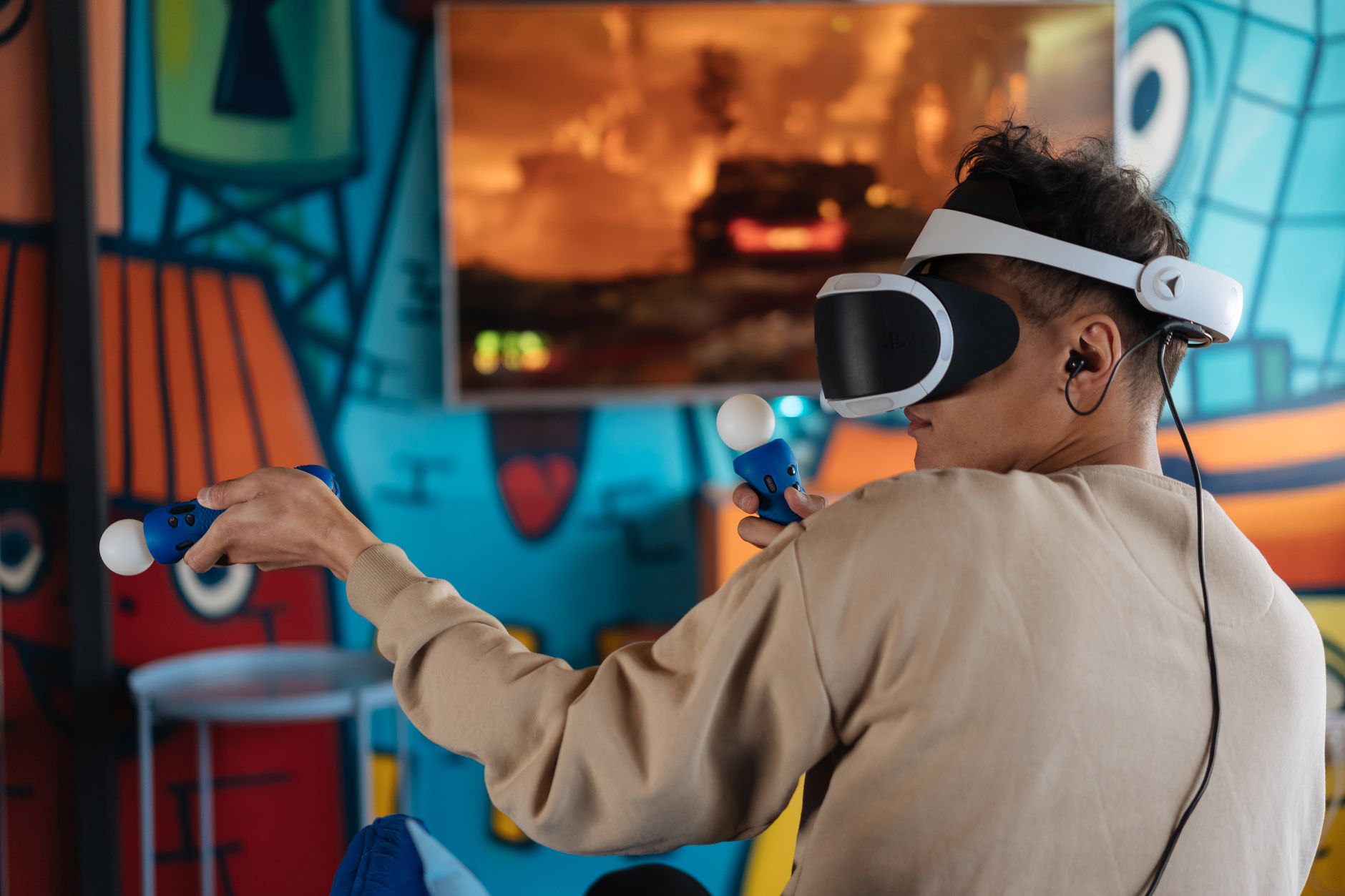
Researchers have developed a new AI framework called Player-1 that helps computer agents learn to play video games more effectively by practicing in synthetic environments rather than relying solely on recorded demonstrations. This approach addresses a key challenge in game AI: the complexity of visually rich game worlds and diverse controls makes it hard for agents to generalize from limited real gameplay data. By creating a variety of simulated training settings and expanding how the AI interacts with games, Player-1 shows promising improvements in mastering game tasks, pointing toward more adaptable and capable digital assistants in the future.
Key Takeaways
- Player-1 improves game-playing success by learning from synthetic experience generated in specially designed virtual environments, not just from real gameplay demonstrations.
- The framework extends traditional computer-use actions by including relative pointer movements, sustained inputs, and combined keyboard-mouse actions to better mimic complex game controls.
- Training on sixteen diverse synthetic 2D and 3D environments helps Player-1 agents generalize skills across different games, leading to significant performance boosts in benchmarks like MineDojo and ViZDoom.
- Agents trained with Player-1 achieve up to 38.33% success on MineDojo-300 tasks, outperforming the previous best baseline by a wide margin.
The team behind Player-1 began by fine-tuning existing computer-use AI models on over 6,000 carefully curated gameplay sessions. These sessions paired recorded player actions with clear task instructions and visual reasoning cues, helping the AI understand what to do and why. However, relying solely on such supervised learning has limitations because the recorded data cannot cover all possible game scenarios.
To overcome this, the researchers created Player-1-Gym, a suite of sixteen synthetic environments designed to capture common control challenges found across many games. These environments are programmatically controlled, allowing the AI to receive verifiable rewards based on its actions and to experience randomized observations and control dynamics. This setup enables reinforcement learning (RL), where the AI learns by trial and error to maximize rewards over time. The team used a popular RL method called Proximal Policy Optimization (PPO), which helps the AI gradually improve without drastic changes that could destabilize learning.
One important innovation in Player-1 is the expanded action space. Traditional computer-use agents typically simulate simple mouse clicks and keyboard presses. Player-1 adds relative pointer motions (how the mouse moves relative to its current position), sustained inputs (holding down keys or buttons), and composite actions that combine multiple inputs simultaneously. These richer controls allow the AI to perform complex maneuvers common in modern games, such as aiming while moving or executing multi-key commands.
Testing Player-1 demonstrated notable improvements. For example, Player-1-9B, a model with 9 billion parameters, achieved a 38.33% success rate on MineDojo-300 tasks—more than triple the 12.63% success of the strongest baseline model. Other versions also showed gains on different game benchmarks like ViZDoom-10 and GameWorld. The researchers also found that training across a broader range of synthetic environments led to better transfer of skills, and that the use of composite actions increased during reinforcement learning, indicating the AI was leveraging its expanded control abilities.
This research highlights a promising direction for building AI agents that can better understand and interact with complex digital environments. By learning from synthetic experience rather than just from human demonstrations, game-playing AI can explore a wider range of scenarios and develop more robust skills. While Player-1 currently focuses on gaming, similar techniques could eventually enhance AI performance in other interactive digital domains requiring nuanced control, such as virtual assistants or robotic interfaces. Future work may explore scaling this approach further and applying it to even more diverse and realistic settings.
Based on research published on arXiv by Mingyu Ouyang, Yiran Wang, Siyuan Hu et al..