
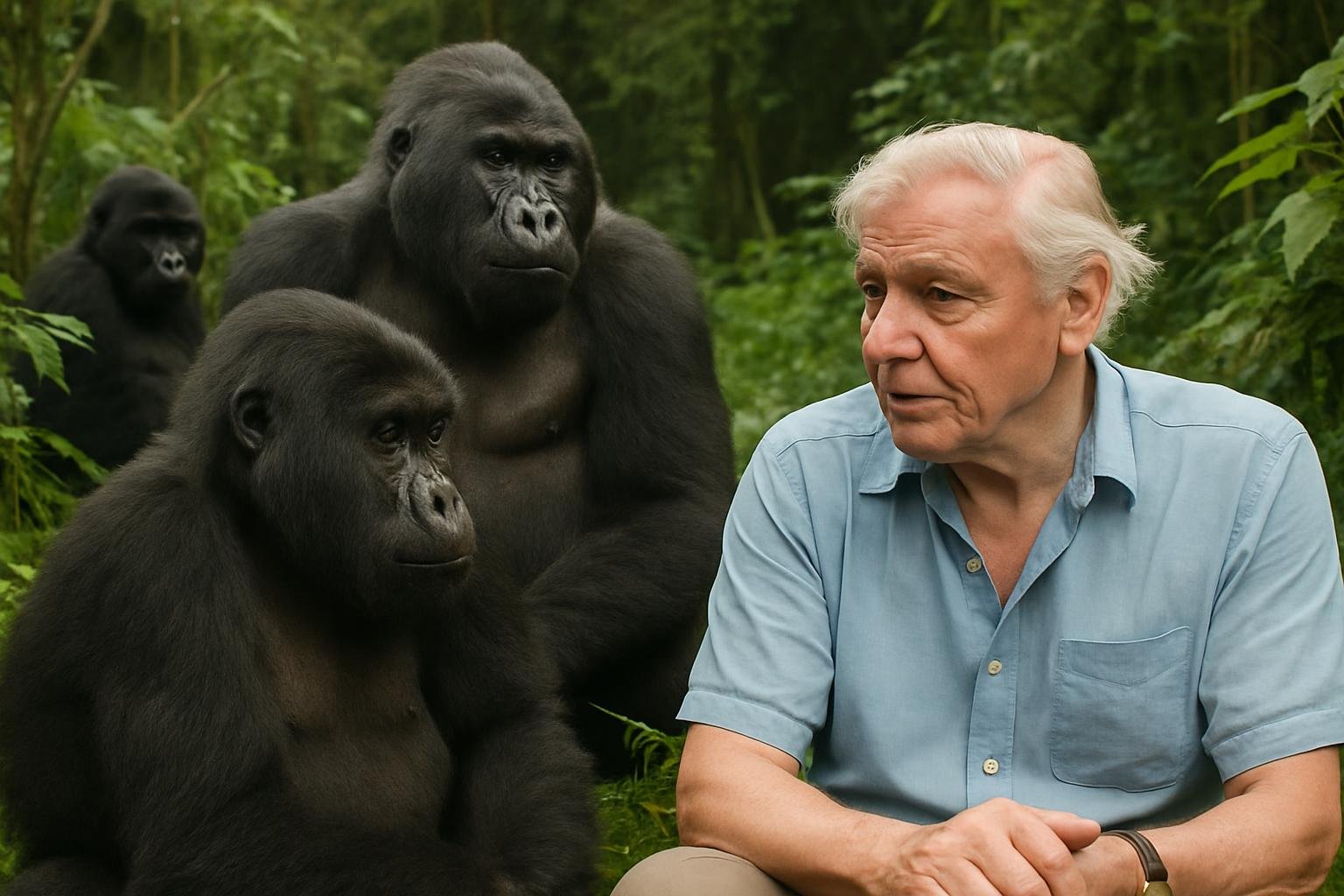
The story behind Attenborough’s iconic TV encounter with gorillas
Sir David Attenborough’s iconic TV encounter with mountain gorillas remains one of the most memorable moments in his broadcasting career. This brief but profound sequence, filmed in a forest clearing in Rwanda, captured a female gorilla observing Attenborough from just a few feet away. The footage, part of the 1979 Life on Earth series, revealed a deep connection and mutual understanding between humans and gorillas, highlighting our close relationship with the natural world.
Filming the encounter in the Virunga Mountains
The story began in January 1978 when Attenborough and his film crew arrived in the Virunga Mountains, Rwanda, with a simple goal: to film a gorilla’s thumb to illustrate the evolutionary development of thumbs and fingers that allow apes to grip tools. The team climbed nearly 10,000 feet up steep slopes to find one of the few surviving mountain gorillas.
At the time, mountain gorillas were critically endangered due to poaching and habitat loss, with fewer than 285 individuals remaining in the Virungas. Approaching these gorillas was difficult, and the crew relied on the expertise of Dian Fossey, a US gorilla specialist who had established the Karisoke Research Centre in Rwanda’s Volcanoes National Park. Fossey’s pioneering conservation work had gained international recognition, but Attenborough initially doubted she would permit a film crew near the gorillas.
After weeks of correspondence, Fossey invited the team to visit. She introduced them to a gorilla family and taught them how to behave around the animals, advising them not to stare directly at the gorillas, which could be seen as a challenge. Instead, they were instructed to keep their heads down and make gentle vocalizations to gain the gorillas’ trust.
The unexpected encounter and its impact
Following Fossey’s guidance, the crew got closer than expected to the gorillas. During filming, a young gorilla named Poppy tried to remove Attenborough’s shoes, while another infant, three-year-old Pablo, lay on Attenborough and touched his head. An adult female gorilla then gently turned Attenborough’s head to look into his eyes, put a finger in his mouth, and made a belching sound. Attenborough responded in kind, creating a moment of mutual recognition and affection.
Only a few minutes of this playful interaction were captured on film due to limited film stock, but the moment was deeply moving for Attenborough. He described it as one of the most privileged and breathtaking experiences of his life, one he still dreams about.
However, the team’s return journey was tense. They encountered armed guards and were detained overnight by Rwandan soldiers, questioned about their work, and held in an army compound before being released. Despite these challenges, their film was not confiscated, and they left Rwanda relieved.
Legacy of the iconic TV encounter
The Life on Earth series, broadcast in 1979, was a landmark in natural history television, reaching an estimated 500 million viewers worldwide. The gorilla encounter changed public perceptions, showing gorillas as intelligent, emotional beings rather than distant jungle creatures.
Attenborough’s experience also inspired conservation efforts. He collaborated with the charity Flora and Fauna to establish the Mountain Gorilla Project, aimed at protecting the species. Although Dian Fossey was tragically murdered in 1985, her work and death raised global awareness of the gorillas’ plight. Conservation and eco-tourism programs followed, and the mountain gorilla population has since increased to around 600 individuals.
A new Netflix documentary, A Gorilla Story: Told by David Attenborough, follows the descendants of Pablo, the young gorilla featured in the original footage. Pablo, who was abandoned as an infant, survived to become the silverback leader of his group, a role reserved for dominant males. He died at age 33 defending his family. The documentary reveals the complex social dynamics of Pablo’s group, including conflicts and mourning, underscoring the rich emotional lives of gorillas.
Dr Tara Stoinski, chief executive of the Dian Fossey Gorilla Fund, notes that the original gorilla encounter surprised viewers with the trust and playful behavior shown by the gorillas. The moment challenged the traditional view of humans observing nature from a distance, instead portraying gorillas as curious observers of Attenborough himself.
Attenborough’s words during the encounter remain poignant: “We see the world in the same way as they do.” This gentle, affectionate meeting between genetic cousins continues to be a defining television moment, illustrating the deep connections between humans and the natural world.
Making Life on Earth: Attenborough’s Greatest Adventure airs on BBC One and BBC iPlayer.