
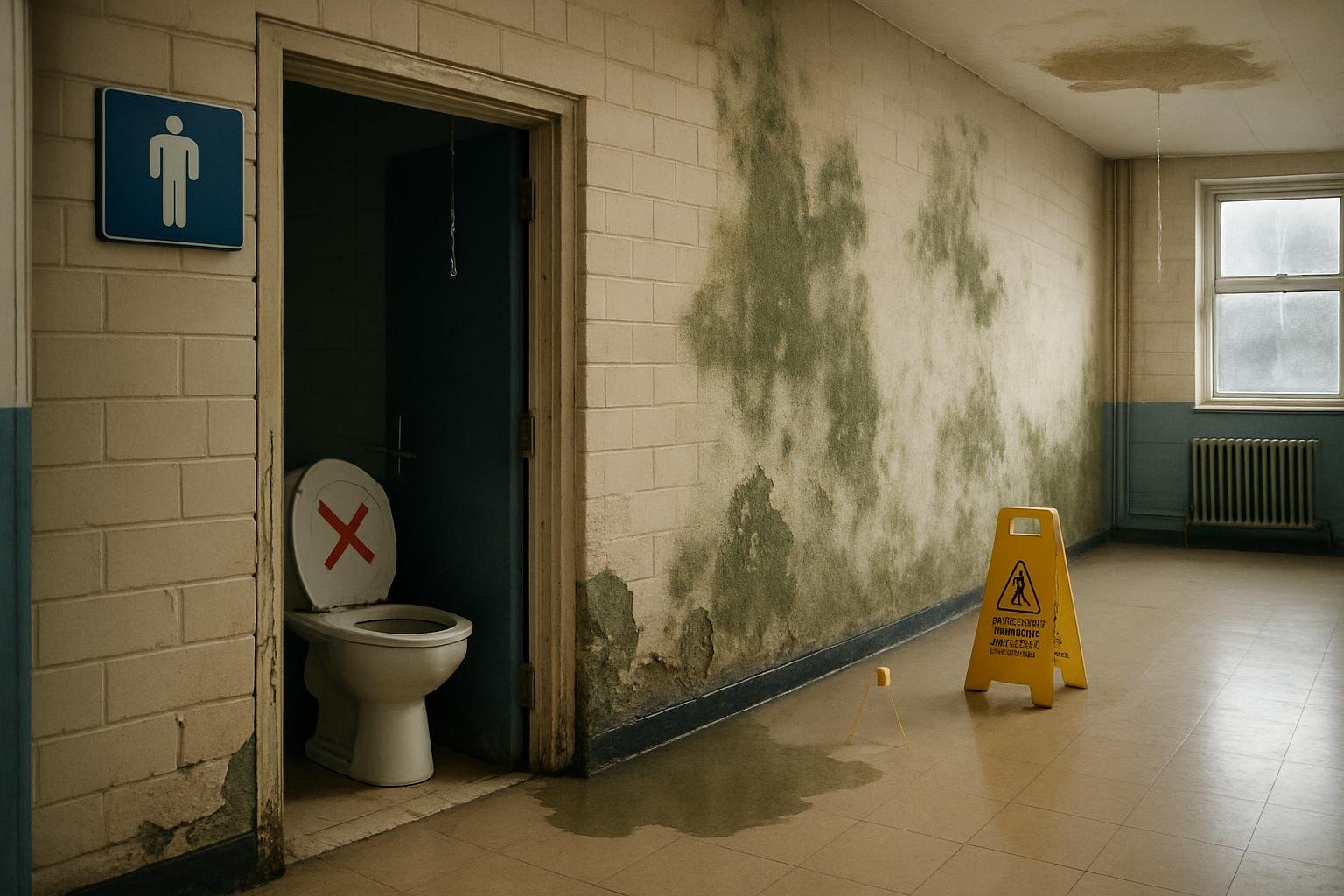
Poll Highlights Widespread Issues with Broken Toilets and School Facilities
A recent survey by the National Association of Head Teachers (NAHT) reveals that half of England’s schools have parts that are unfit for use due to various maintenance problems. These include leaks, damp, mould, asbestos, ageing boilers, and malfunctioning fire doors. Among these issues, broken toilets stand out as a significant concern, with nearly three-quarters of affected schools reporting toilet blocks that are either closed or not fit for purpose.
Extent of Problems with Broken Toilets and Other Facilities
According to the NAHT survey, 73% of headteachers from schools experiencing disrepair say their toilet blocks are problematic. Specifically, 8% report that toilet blocks are closed, while 65% say they are not fit for purpose. One headteacher described urgent needs for toilet replacements but lacked the funds to carry out repairs. The survey also found that other parts of school infrastructure are suffering:
- 41% of schools have facilities for children with special educational needs and disabilities (Send) that are unfit for use, including classrooms, sensory rooms, and outdoor spaces.
- 64% report playgrounds that are either unsuitable (56%) or closed (8%).
- Additional issues include leaking roofs, mould-covered walls, sinking floorboards, unfit windows, and non-compliant fire doors.
Funding Challenges and Government Response
Almost all headteachers surveyed (96%) stated they do not receive sufficient capital funding to maintain their school buildings. The National Audit Office estimates that £14 billion is needed to restore school buildings in England to a satisfactory condition.
Paul Whiteman, general secretary of NAHT, acknowledged the government’s plans for additional investment through a new 10-year estates strategy but emphasized the scale of the challenge, especially given inflationary pressures.
The Department for Education responded by highlighting ongoing efforts to address the decline in school infrastructure. They noted a commitment to removing reinforced autoclaved aerated concrete (Raac) and investing nearly £3 billion per year over the next decade to improve school and college conditions.